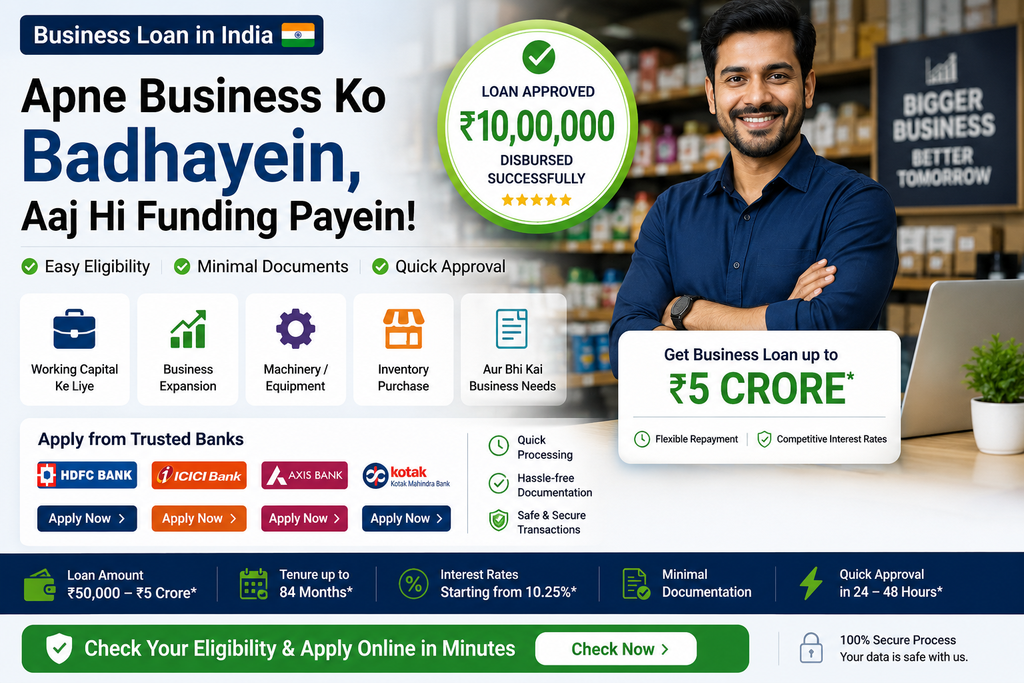
Running a business often means spending money before you actually receive money from customers.
You may need funds to purchase inventory, expand your shop, buy equipment, manage working capital, open another location or handle an unexpected business expense.
A business loan can be one way to arrange that funding without using all of your personal savings.
However, getting a business loan is not simply about filling out an online form and receiving money. Lenders look at the business, its financial position, repayment capacity and other details before making a decision.
This guide explains how business loans work, who may qualify and what you should check before applying.
What Is a Business Loan?
A business loan is financing provided to an eligible business owner or business entity for permitted business-related purposes.
Depending on the lender and product, financing may be available for things such as:
- Working capital
- Purchasing inventory
- Business expansion
- Machinery and equipment
- Renovation or improvement of business premises
- Business-related expenses
- Other approved commercial requirements
The exact purpose, loan amount, repayment period, interest rate and security requirements depend on the lender and the particular loan product.
Who Can Apply for a Business Loan?
Business-loan eligibility can vary significantly between lenders.
Depending on the product, an applicant may be assessed on factors such as:
- Business vintage
- Annual turnover
- Profitability
- Banking transactions
- Credit history
- Existing loans and obligations
- Business registration
- Income and financial records
- Nature of the business
- Repayment capacity
A self-employed professional, small shop owner, manufacturer and established company may all have very different eligibility requirements.
So, don’t assume that a business loan advertised online will automatically be available to every business.
How Much Business Loan Can You Get?
There is no universal loan amount that applies to every business.
The lender may consider your turnover, cash flow, business history, credit profile, existing liabilities and the purpose of borrowing.
For example, a business that has been operating consistently for several years with documented revenue may be assessed differently from a newly started business with limited financial history.
The final amount is decided by the lender after its assessment.
Axis Bank’s business-loan documentation, for example, states that the bank may sanction or decline an application at its discretion and that there is no commitment regarding the loan amount.
What Documents Are Usually Required?
The documents depend on the lender, business structure and loan product.
You may be asked for:
- PAN and identity documents
- Address proof
- Business registration documents
- GST-related documents, where applicable
- Bank statements
- Income-tax returns
- Financial statements
- Proof of business ownership
- Details of existing loans
- Business address proof
- Other documents required for credit assessment
Keeping your financial records organised can make the application process easier.
If your business has multiple owners or partners, additional documents may also be required.
Business Loan Interest Rates
Interest rates are an important part of the total cost of borrowing.
The rate offered to a business can depend on several factors, including the lender, loan product, business profile, credit history, financial performance, loan amount and repayment period.
This means two businesses may receive different offers.
Instead of looking only at an advertised starting interest rate, compare the complete cost of the loan.
Check:
- Interest rate
- Processing fee
- Documentation charges
- Applicable taxes
- Prepayment or foreclosure charges
- Other applicable fees
- Repayment schedule
For digital lending, RBI’s regulatory framework places emphasis on transparent disclosure of the cost of borrowing and APR-related information where applicable.
Secured vs Unsecured Business Loans
Business financing can broadly be offered with or without collateral, depending on the product.
Unsecured Business Loan
An unsecured business loan generally does not require the borrower to pledge a specific asset as security.
However, the lender may have stricter eligibility requirements and assess the business and borrower’s financial profile carefully.
Secured Business Loan
A secured facility involves security or collateral as specified by the lender.
Because the structure is different, the eligibility, pricing, documentation and risk can also be different.
Always understand what security is being requested before signing the loan documents.
What Can Improve Your Chances of Getting a Business Loan?
There is no guaranteed method of getting approved, but having a well-documented and financially healthy business can make the assessment easier.
Before applying, consider:
Keep business records organised
Maintain proper invoices, bank records, tax filings and other financial documents.
Separate personal and business finances
A dedicated business banking relationship can make your business cash flow easier to understand.
Manage existing debt
Multiple outstanding loans and high monthly repayments can affect your repayment capacity.
Maintain a good credit history
Paying existing credit facilities on time can help demonstrate responsible repayment behaviour.
Borrow for a clear purpose
Know exactly why you need the money and how the borrowed funds will support the business.
Can a New Business Get a Business Loan?
It depends on the lender and loan product.
A newly established business may have less financial history for the lender to evaluate, so it may not qualify for every business-loan product.
Some financing options are specifically designed for smaller businesses or particular categories of borrowers.
If your business is new, check the lender’s eligibility criteria before submitting multiple applications.
Government-Backed and Small-Business Financing
Small businesses may also come across government-supported financing programmes such as the Pradhan Mantri MUDRA Yojana.
Eligibility, loan category, amount, purpose and lending conditions depend on the applicable scheme and lender.
Do not assume that a government-linked programme means automatic approval.
The lender still has to assess the application according to the applicable requirements.
For example, Axis Bank’s business-loan documentation references the possibility of tagging eligible unsecured facilities for small/micro enterprise borrowers under Shishu, Kishor or Tarun categories of PMMY, subject to applicable guidelines.
Where Can You Apply for a Business Loan?
If you want to explore a business loan, start with the official website of a bank or regulated lender.
Some established banks provide business-loan information and application options online:
- HDFC Bank — Visit HDFC Bank’s official website
- ICICI Bank — Visit ICICI Bank’s official website
- Axis Bank — Visit Axis Bank’s official website
Before submitting an application, check the lender’s current eligibility criteria, interest rate, fees, documentation requirements and other terms.
RBI also advises consumers to verify whether a digital lending app is associated with an RBI-regulated bank or NBFC through the lender’s website, rather than trusting random links received through SMS or social media.
Be Careful With Business Loan Scams
Business owners are often approached with messages promising extremely quick funding.
Be careful if someone says:
- “Guaranteed business loan”
- “No verification required”
- “Loan approved without documents”
- “Pay a fee to release the loan”
- “Send your OTP to complete verification”
- “Send your banking password”
- “We can change your credit report”
These are major warning signs.
Use the lender’s official website or verified application channel instead of clicking unknown loan links.
Never share your OTP, card PIN, CVV, internet-banking password or other confidential banking credentials with an unknown person.
How Should You Decide How Much to Borrow?
This is one of the most important questions before taking a business loan.
Don’t start with:
“How much will the bank give me?”
Start with:
“How much does my business actually need?”
For example, if you need ₹5 lakh to purchase inventory, borrowing ₹10 lakh simply because you qualify for it may increase your repayment burden unnecessarily.
Prepare a simple estimate:
- How much money do I need?
- What will I use it for?
- How much additional cash flow could it generate?
- What will my monthly repayment be?
- Can the business comfortably handle that repayment?
If the numbers don’t make sense, consider borrowing less.
What Happens After You Apply?
The lender normally reviews the information and documents provided with the application.
Depending on the product, this may involve checking:
- Business details
- Credit history
- Bank transactions
- Income and financial information
- Existing liabilities
- KYC documents
- Other information required for underwriting
The lender may approve, modify or decline the application.
Approval is not guaranteed, and the final loan amount and terms depend on the lender’s assessment.
Axis Bank’s published business-loan application documentation similarly states that sanction is at the bank’s discretion and that the bank decides the loan amount/facility.
Final Thoughts
A business loan can be useful when the money has a clear purpose and the business has enough cash flow to manage the repayment.
Before applying, compare lenders rather than choosing an offer only because it advertises a large loan amount or a low starting rate.
Read the complete terms, understand the fees and repayment schedule, and apply through an official lender channel.
Most importantly, don’t borrow more than your business can reasonably repay.
A well-planned loan can support business growth. A poorly planned loan can put unnecessary pressure on your business cash flow.