Sometimes you need money for something that cannot wait.
It could be a medical expense, wedding, home renovation, education, a large purchase, or simply an unexpected financial requirement. In such situations, a personal loan can be one option to consider because it usually does not require you to pledge a property or other major asset as security.
But before applying, it is important to understand how personal loans actually work, what lenders look at, how much the loan may cost, and where you can safely apply.
This guide explains the basics in simple terms so you can make a more informed decision.
What Is a Personal Loan?
A personal loan is generally an unsecured loan offered by a bank or other regulated lender. You borrow a specific amount and repay it through monthly EMIs over an agreed period.
Unlike a home loan or car loan, a personal loan is usually not tied to one particular asset. The lender primarily looks at factors such as your income, employment or business profile, credit history, existing obligations and repayment capacity.
The amount you can borrow, interest rate, tenure and other terms depend on the lender and your individual profile. There is no single personal-loan offer that applies to everyone.
Why Do People Take Personal Loans?
Personal loans can be used for several legitimate personal expenses, depending on the lender’s terms.
Common reasons include:
- Medical or emergency expenses
- Wedding-related expenses
- Home renovation
- Education expenses
- Travel or other planned purchases
- Debt consolidation
- Large personal expenses
However, taking a loan is still a financial commitment. The fact that a lender offers a certain amount does not necessarily mean you should borrow the entire amount.
A good rule is to borrow only what you reasonably need and can comfortably repay.
Who Can Apply for a Personal Loan?
Eligibility varies between lenders.
Banks commonly consider factors such as:
- Age
- Monthly income
- Employment or business status
- Credit history and credit score
- Existing loans and EMIs
- Banking relationship
- Repayment capacity
- Required KYC and income documents
For example, Axis Bank’s published personal-loan information lists indicative age and income criteria and notes that the actual requirements may vary depending on the individual case.
This is why seeing an advertised loan amount does not mean every applicant will qualify for the same amount.
Documents Usually Required
The exact document list depends on the lender and applicant profile.
You may be asked for documents such as:
- PAN card
- Aadhaar or another acceptable identity/address document
- Salary slips or income proof
- Bank statements
- Employment-related documents
- Passport-size photograph
- Other documents requested during verification
For example, Axis Bank’s published documentation includes identity/address proof, income proof and bank statements, while noting that additional documents may be requested.
Keep your documents ready and make sure the information you provide is accurate. Incorrect or incomplete information can delay the application or affect the lender’s decision.
How Much Personal Loan Can You Get?
There is no fixed amount that every applicant can receive.
A lender generally assesses your income, existing financial commitments, credit profile and ability to repay before deciding the loan amount.
For example, someone with a stable income and limited existing debt may have a different eligible amount from someone who already has several EMIs.
It is better to think about your monthly repayment first rather than starting with the maximum amount you can borrow.
Example
Suppose you are considering a loan of ₹5 lakh.
Before applying, ask yourself:
Can I comfortably pay the EMI every month even if my expenses increase?
Also remember that the EMI is not the only cost. Depending on the lender and product, there may be processing fees, taxes, prepayment or other applicable charges.
What Is the Interest Rate on a Personal Loan?
The interest rate is one of the most important things to check before accepting a loan.
The rate offered to you can depend on your credit profile, income, employment, relationship with the lender, loan amount, tenure and the lender’s applicable pricing.
Do not choose a loan only because the advertised starting interest rate looks attractive. The rate actually offered to you can be different.
You should also look at the Annual Percentage Rate (APR) and applicable fees when comparing digital loan offers. RBI’s regulatory framework emphasizes transparent disclosure of the all-inclusive cost of digital loans, including APR.
Personal Loan EMI
Your EMI depends mainly on:
- Loan amount
- Interest rate
- Loan tenure
A longer tenure can reduce the monthly EMI, but it can also increase the total interest paid over the life of the loan.
For this reason, do not automatically choose the longest available tenure.
If your income allows it, a shorter tenure may reduce the overall interest cost. But your EMI should still remain manageable.
Where Should You Apply?
If you decide that a personal loan is suitable for you, use the lender’s official website or official application channel.
Avoid random websites, WhatsApp numbers, social-media messages or people claiming that they can guarantee approval.
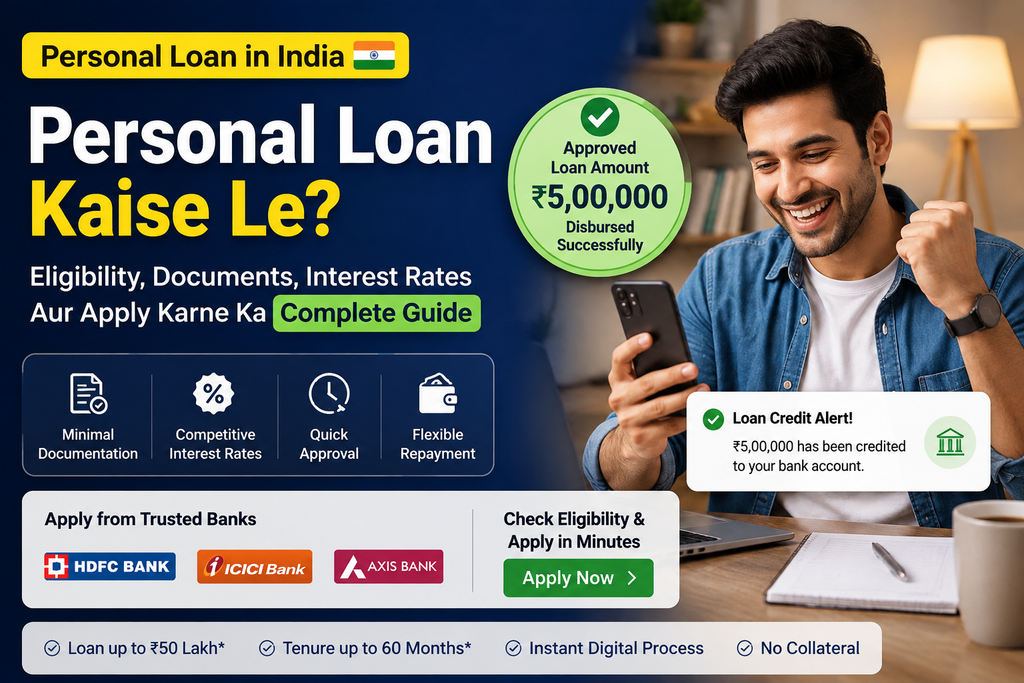
You can check personal-loan options directly with established banks such as:
- HDFC Bank — Visit HDFC Bank’s official website
- ICICI Bank — Visit ICICI Bank’s official website
- Axis Bank — Visit Axis Bank’s official website
ICICI Bank also provides an online loan application/document process through its official banking domain.
Always check that you are on the bank’s genuine website before entering personal information.
Be Careful With Loan Scams
This is particularly important when searching for loans online.
A genuine lender will have a proper application and verification process. Be cautious if someone tells you:
- “100% loan approval guaranteed”
- “No documents required”
- “Pay money first and your loan will be released”
- “Send your OTP to confirm the loan”
- “Give us your banking password”
- “Your CIBIL score does not matter at all”
Never share your banking password, card PIN, CVV or OTP with an unknown person.
Also check the complete loan terms before accepting an offer, including interest rate, APR where applicable, processing fees, repayment schedule and other charges.
What Can Affect Your Loan Approval?
There are several reasons why one applicant may receive an offer while another may not.
Some common factors include:
Credit history: Your past repayment behaviour can influence how lenders assess your application.
Income: Lenders need to understand whether your income is sufficient to support the proposed repayment.
Existing EMIs: If you already have multiple loans, your repayment capacity may be lower.
Employment or business stability: Lenders may consider your income source and stability.
Documentation: Missing or inconsistent information can create problems during verification.
Ultimately, the lender decides whether to approve the application and on what terms.
Should You Take a Personal Loan?
A personal loan can be useful when you have a genuine financial requirement and a clear repayment plan.
But it is not free money.
Before applying, calculate your expected EMI and look at the total repayment amount. Compare more than one lender rather than accepting the first offer you see.
If the EMI would put significant pressure on your monthly budget, consider whether you can reduce the loan amount, delay the expense, or explore another financing option.
Final Thoughts
A personal loan can provide access to funds when you need them, but the right loan is not necessarily the loan with the biggest amount or the lowest advertised rate.
Look at the complete cost, understand the repayment schedule, check your eligibility and apply through a genuine lender.
Most importantly, never assume that approval is guaranteed. The final decision, loan amount, interest rate and terms depend on the lender’s assessment of your application.
If you decide to apply, start with the official website of the bank or regulated lender, read the terms carefully, and provide accurate information during the application process.